
Provider Insights
FDA-Cleared vs. Non-FDA-Cleared Pelvic Floor Chairs: What Practice Owners Should Know
Two pelvic floor therapy devices can look almost identical. They may have similar chairs, control screens, treatment settings, and marketing claims. They may even use the same type of energy. But one device may have FDA clearance for a specific medical purpose, while another may not be authorized for the same use. That distinction matters when evaluating a device for patient care.
Two pelvic floor therapy devices can look almost identical. They may have similar chairs, control screens, treatment settings, and marketing claims. They may even use the same type of energy.
But one device may have FDA clearance for a specific medical purpose, while another may not be authorized for the same use. That distinction matters when evaluating a device for patient care.
Before investing in a device, your first question should not be, “How much does it cost?” It should be, “Is this exact device FDA-cleared for the medical use I intend?”
What Does “FDA-Cleared” Mean?
The terms “FDA-cleared” and “FDA-approved” are often used interchangeably. But they don't mean the same thing. Drugs generally receive FDA approval, while many medical devices receive FDA clearance through the 510(k) premarket notification process.
A medical device receives 510(k) clearance when its manufacturer demonstrates that the device is substantially equivalent to a legally marketed predicate device. FDA evaluates factors such as the device’s intended use, technological characteristics, performance, and applicable safety information.
A device is considered substantially equivalent when it has the same intended use as the predicate device. It must also have either the same technological characteristics as the predicate or different ones that do not raise questions of safety and effectiveness.
Substantial equivalence does not mean two devices must be identical. It means the manufacturer provided information to the FDA showing that the new device is similar enough to the legally marketed predicate device for the same intended use.
A device’s intended use describes its general purpose, while the indications for use provide more specific details about the condition, patient population, or circumstances it is designed for. These details help determine whether a new pelvic floor chair has the same intended use as its predicate device for substantial equivalence.
FDA clearance is not an endorsement of a product or company. It also does not guarantee that a device can never malfunction. Instead, it means the device completed the applicable FDA premarket review process and may be legally marketed for the indications included in its clearance.
Also, 510(k) clearance is different from Premarket Approval (PMA). A 510(k) submission establishes a device's substantial equivalence to a legally marketed predicate, while the PMA involves a different and more extensive FDA review of safety and effectiveness.
As a practice owner, check for an “FDA-cleared” label when evaluating a device. Look for the specific clearance, intended use, and indications for the device you’re looking for. Then, consider those details alongside clinical evidence and your practice’s needs.
Why FDA Clearance Matters
If you’re looking to buy a pelvic floor chair, FDA clearance gives you a verifiable regulatory foundation for evaluating the device. It helps you confirm what the device is cleared to do and whether it fits your intended use.
Clearance documentation can provide important details, including the following:
- The company that holds the clearance
- The exact device name and product code
- The device’s intended use and indications for use
- The predicate device and technological characteristics reviewed by the FDA
- The performance information supporting the clearance
This information is more reliable than a salesperson’s claims, promotional materials, or unofficial certificates. You can also independently verify a device’s regulatory status through the FDA’s public database.
Clearance also defines the scope of how a device can be marketed and used. A device cleared for non-invasive electromagnetic stimulation of weak pelvic floor muscles for rehabilitation and urinary incontinence is not automatically cleared for every pelvic health concern. For example, claims involving sexual dysfunction, pelvic organ prolapse, bowel incontinence, pelvic pain, or postpartum conditions may require separate regulatory support.
Before comparing features, pricing, or business models, verify that the exact device model you are considering has appropriate FDA clearance or authorization for its intended use. This regulatory due diligence gives you a clear foundation for evaluating the device’s safety, clinical use, and fit within your practice.
FDA Clearance Is More Than a Marketing Phrase
When you’re considering a pelvic floor chair, its manufacturer should provide an identifiable 510(k) number to support the claim that it is FDA-cleared. You can use this number to check the device’s FDA clearance and review the information submitted to the FDA.
Depending on the device and technology, the FDA review of the manufacturer’s submission may address these factors:
- Electrical safety and electromagnetic compatibility
- Software performance and safety
- Energy output and treatment parameters
- Temperature and overheating risks
- Mechanical performance and reliability
- Device durability, labeling, warnings, and contraindications
The specific testing requirements by the FDA can vary by device. But FDA clearance does not mean a device is completely risk-free. It means the device has gone through the applicable FDA premarket review process for its stated intended use.
This distinction matters when you’re planning to add a pelvic floor therapy chair to your patient care. It gives you a regulatory record you can verify instead of relying solely on the manufacturer’s marketing claims.
What Is a Non-FDA-Cleared Medical Device?
A non-FDA-cleared medical device is one that is promoted for a medical purpose that requires FDA clearance but has not received it.
The medical purpose entails what the device is intended to do and the medical conditions for which it is used. If a seller says that a pelvic floor chair treats urinary incontinence, rehabilitates weakened pelvic floor muscles, restores neuromuscular control, or addresses another diagnosed condition, these are medical claims. The seller should support them by providing the applicable FDA clearance number for the exact device and model being offered.
A manufacturer cannot market a product for medical treatment merely because it resembles an FDA-cleared device or uses similar technology. If they advertise the product as treating a disease or medical condition, calling it a “wellness device” does not change the medical nature of its intended use.
That’s why you should look beyond how a pelvic floor chair is marketed. Check the manufacturer’s stated intended use or medical purpose. Also, confirm that the FDA clearance applies to the exact model and covers how you plan to use the device in patient care.
Similar Technology Does Not Equal FDA Clearance
If the device you’ve selected uses technology similar to an FDA-cleared product, do not assume it has the same FDA clearance. Clearance applies to the specific device reviewed by the FDA. It does not automatically extend to another manufacturer, model, brand, software version, or treatment protocol.
You should also know that a manufacturer cannot use another company’s FDA clearance for its own device. A distributor cannot establish clearance by saying that its product contains a similar coil, uses electromagnetic energy, or looks like an FDA-cleared device.
When evaluating a device, consider differences in energy output, pulse characteristics, software controls, cooling systems, materials, manufacturing quality, and treatment parameters. Always verify that the exact device you’re buying is covered by the regulatory documentation provided by the manufacturer.
The Dangers of Using a Non-FDA-Cleared Device on a Patient
When you use a device without the required FDA clearance, you expose your patients to risks that have not been adequately evaluated. Without appropriate documentation, you may not know whether the device has undergone the necessary safety and performance testing or operates consistently within its stated specifications.
Potential patient risks include the following:
- Excessive or inconsistent energy delivery
- Unexpected heating, pain, or muscle injury
- Electrical or electromagnetic hazards
- Software, control system, or emergency-stop failures
- Incomplete contraindications or patient-screening guidance
- Mechanical or component failures
- Unexpected interactions with implants or medical conditions
A lack of verifiable FDA clearance does not automatically mean the device is dangerous. The concern is that you may not have reliable evidence showing that the device underwent appropriate review and testing for its claimed medical use.
When you use the device in patient care, that uncertainty becomes your responsibility as a practice owner.
The Risks Extend Beyond Patient Safety
Getting a non-FDA-cleared device can create risks for your practice beyond patient safety.
Professional liability
If a patient gets injured, you may need to justify why you chose a device without the required FDA clearance for its intended use. While you may be tempted to choose a lower-priced device to save money upfront, you are still responsible to do your due diligence before using it on patients.
Regulatory exposure
You may face regulatory concerns if a seller markets a device with unsupported medical claims. Steer clear of repeating those claims in consultations, consent forms, websites, advertisements, or social media unless you can verify them.
Insurance and reputation
Your professional-liability insurer may review whether you legally marketed, properly maintained, and used the equipment according to its labeling. An injury or regulatory issue associated with an inadequately documented product can also damage the trust you have built with patients over the years.
Limited manufacturer accountability
A seller may not provide reliable training, servicing, complaint handling, adverse-event reporting, corrective actions, or recall support. This gives you limited access to clear instructions, troubleshooting guidance, replacement parts, or technical support when you need them.
Without established manufacturer processes, you may have to manage device issues, maintenance, and patient concerns on your own.
FDA Registration Is Not FDA Clearance
When you’re evaluating a pelvic floor chair, watch for language that sounds like FDA approval but does not establish FDA clearance.
Be cautious when you see these keywords:
- “FDA registered” or “FDA listed”
- “FDA certified”
- “Manufactured in an FDA-registered facility”
- “FDA registration certificate”
- “Uses FDA-cleared technology”
These statements do not replace FDA clearance. A company’s registration does not mean the FDA reviewed and cleared every product it sells. The FDA also does not issue registration certificates as proof that it reviewed and cleared a device.
Similarly, a device does not become FDA-cleared because it uses an FDA-cleared component or similar technology. So, always verify the regulatory status of the exact device you’re considering.
How to Verify a Device’s FDA Clearance
Before you purchase a pelvic floor chair, verify its FDA clearance independently. Do not rely only on a certificate, brochure, website, or salesperson’s statement. Ask for the exact 510(k) number and use it to verify the following:
- The clearance holder and trade name
- The exact device model and product code
- The clearance date
- The intended use and indications
- The device description
- The seller’s relationship with the clearance holder
Make sure the device you receive matches the product listed in the FDA documentation. If the seller uses a different brand or name, ask for documentation showing its relationship to the clearance holder.
If a seller cannot provide a 510(k) number and offers only a registration certificate, this can be a warning sign. Investigate further before you purchase the device.
FDA-Cleared Does Not Mean “Cleared for Everything”
An FDA-cleared pelvic floor chair is cleared for a specific intended use and indications. A 510(k) number alone does not mean you can use or promote the device for every pelvic floor condition.
Check the device’s clearance to understand exactly what it is intended to treat and who it is intended for. This will ensure that your use and marketing remain consistent within that scope.
Also, be mindful of statements such as “treats every type of pelvic floor dysfunction,” “guaranteed to cure incontinence,” “produces permanent results,” or “completely risk-free.” Avoid using such claims unless the device’s clearance and reliable evidence support them.
Price Should Never Come Before Patient Safety
A non-FDA-cleared EMS chair for pelvic floor problems may cost considerably less than an FDA-cleared one. This lower purchase price can be appealing, especially when you’re introducing a new service. But the upfront cost does not tell you the full cost of owning and using a device. It is only a part of the true cost.
Maintenance, repairs, replacement parts, training, warranty coverage, and manufacturer support can all affect your budget and daily operations. Limited support or unexpected repairs can cause downtime, treatment cancellations, and additional costs.
A less-expensive device may also create costs through unreliable performance, patient complaints, liability exposure, regulatory issues, or reputational damage.
The most expensive device is not automatically the best choice either. But don't let discounts outweigh whether a device is properly tested, legally marketed, reliably supported, and appropriate for patient care.
Questions to Ask Before Treating the First Patient
As you introduce a new pelvic floor chair to your practice, a thorough device review helps confirm its regulatory status, safety information, and manufacturer support. Use these questions to guide your due diligence before using the device in patient care:
- What is the exact FDA 510(k) number?
- Does that clearance cover this exact device and model?
- Who owns the clearance, and is the seller authorized to distribute it?
- What are the intended uses and indications?
- Do those indications support the advertised medical claims?
- What safety and performance testing was completed?
- What warnings and contraindications apply?
- What training, warranty, service, and replacement support are provided?
- Who handles complaints and adverse events?
- Can every regulatory claim be independently verified?
The Bottom Line
A pelvic floor therapy device becomes part of your patient care the moment you use it to address a medical condition. That decision deserves more scrutiny than comparing appearance, advertised power, treatment time, or price.
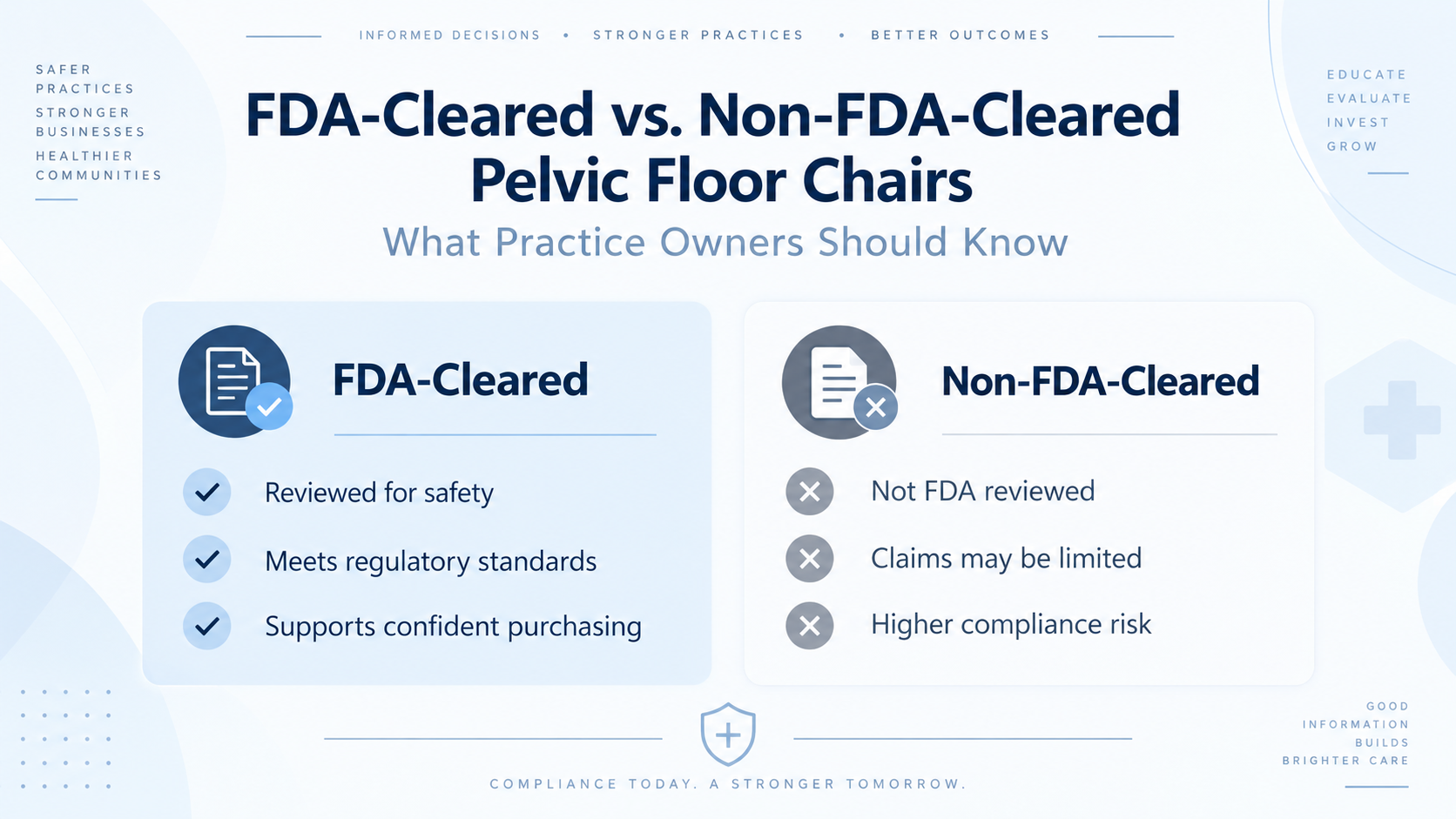
An FDA-cleared device has an identifiable regulatory history, defined intended use, specific indications, and documented information supporting its substantial equivalence to a legally marketed predicate. A device lacking required clearance may not have undergone the applicable review or testing for its claimed use.
Before using any pelvic floor device on a patient, verify three things: Is this exact device FDA-cleared? Does its clearance cover the condition being treated? Can its important claims be confirmed through official FDA documentation?
If those questions cannot be answered, the potential risk may be far greater than the apparent savings.
For example, the ReStora EMS Chair has FDA 510(k) clearance for non-invasive electromagnetic stimulation of weak pelvic floor muscles for rehabilitation and urinary incontinence in both men and women. Its clearance gives you a defined regulatory scope for evaluating the device’s features, treatment protocols, and intended patient population.
Such a thorough review can help you choose a pelvic floor therapy chair that suits your patients and practice.